How to start a startup, step by stepFrom an idea in your Notes app to people paying for it.
Going from 0 to 1 is the loneliest part of building a startup. This is the path from idea to first customers, and what it looks like with one team beside you, from market research and brand to the build, the launch and your first ads.
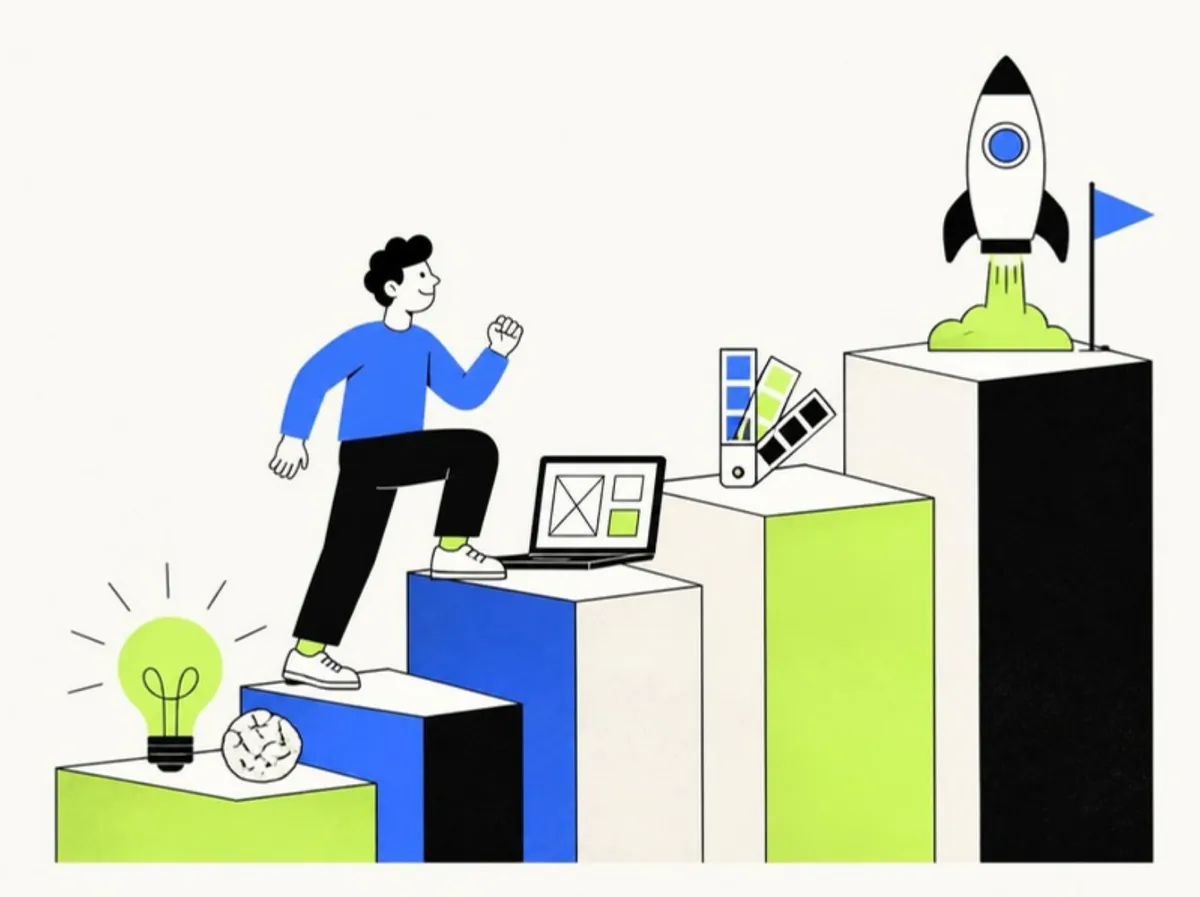
- Idea
- Research
- Brand
- Build
- Launch
- Grow
Common problems first-time founders face
Things founders tell us on the first call.

“I have the idea. I just don’t have a tech co-founder.”
“My cousin said he’d build it on weekends. That was March.”
“One agency quoted 9 months. I don’t have 9 months of savings.”
“I’ve rewritten the pitch deck 14 times. There’s still no product.”
“Investors keep asking “do you have traction?” How, without a product?”
“The freelancer stopped replying. And he has the code.”
If you nodded at even one of these, you’re not behind. You’re at Day 0, and Day 0 is exactly where we start.
Startup expectations vs reality
Nobody’s line is straight.
We can’t make the line straight. Nobody can. What we can do is take the costly loops out, like the ghosted freelancer, the rebuild and the six months with nothing to show, so you get there faster.
How to start a startup: the path from idea to first customers
Day 0 to Day 1, step by step.
What you’ll be thinking, what we’ll be doing, and what you’ll have at the end of each stage.
- Step 01
Define the problem
Mood: Excited and overwhelmedYou, thinking“It’s like Uber, but for… also it needs AI, a marketplace, chat, payments and an admin panel.”
What we doWe start by listening. Who has the problem, how do they solve it today, and what would make them pay for something better?
Where you landClarity on whether, and what, to build
- Step 02
Market research and idea validation
Mood: Humbled, then sharperYou, thinking“Nobody else is doing this. Wait… there are 11 apps doing this?”
What we doWe tear down your competitors, talk to the people who have the problem, check what they pay today and find the gap the others leave open.
Where you landKnowing who to target first, and why you win

- Step 03
Scope the MVP
Mood: Uncomfortable, in a good wayYou, thinking“Wait, you want me to cut payments? And chat? What’s even left?”
What we doWe map one user, one problem and the shortest path to solving it. Everything else goes on a “later” list, not in the bin.
Where you landOne user, one problem, one focused first version
- Step 04
Brand identity and guidelines
Mood: Finally looks like a companyYou, thinking“I made a logo in Canva at 1am. It’s… fine? I think?”
What we doName and domain check, logo, colours, type and tone of voice, built for the people your research found. Then brand guidelines so everything stays consistent.
Where you landA brand that looks like a real company everywhere

- Step 05
Clickable prototype
Mood: It’s real nowYou, thinking“I showed it to 10 people. 7 said “when can I use it?” 3 said the signup is confusing.”
What we doDesigns you can click through on your phone, before a single line of code. You can put it in front of users and investors early.
Where you landSomething to show, and feedback that is cheap to act on
- Step 06
Build the MVP
Mood: Impatient, but in controlYou, thinking“Every Friday I can open the app and see what changed. I stopped asking “so what’s the status?””
What we doSenior engineers build in short cycles, with regular live demos and a shared tracker you can follow, so you always know where things stand.
Where you landA working product that grows with every cycle
- Step 07
Organic reach audit
Mood: Ready to be foundYou, thinking“I posted on LinkedIn. 14 likes. 9 of them were family.”
What we doWe audit your SEO, Google Business profile and social accounts, fix the basics, set up analytics and plan the content that brings people in without paying for every click.
Where you landA presence people can find without paying for it
- Step 08
Launch the product
Mood: Terrified. Thrilled.You, thinking“Someone I have never met just signed up. Someone I have never met just PAID.”
What we doApp store submissions, error tracking and a quiet launch first, so the loud launch and the ads don’t break anything.
Where you landA live product, real users and real numbers
- Step 09
Ads setup
Mood: Spending on purposeYou, thinking“There’s a “Boost post” button. Is that… marketing?”
What we doMeta and Google ad accounts in your name, pixels and conversion tracking that actually work, and small test campaigns with creatives in your new brand. Budgets grow only when the numbers say so.
Where you landPaid growth you can actually measure

- Step 10
Grow from 0 to 1
Mood: Founder, not project managerYou, thinking“Now when investors ask about traction, I open the dashboard.”
What we doWe read the data with you, fix what users trip over and help plan what comes next, whether that is v2, a raise or your first hire.
Where you landA product with real users and a clear next step
Market research, branding and marketing for startups
A product nobody finds is still at 0.
Most dev shops hand you an app and wave goodbye. Getting to 1 also takes knowing your market, looking like a real company and getting in front of the right people. So that is part of the journey too.
Market research
So you build for a market that exists, not one that lives in your head.
- Competitor teardown and positioning map
- Customer interviews and problem validation
- Pricing benchmarks
- Target segment to win first
Brand guidelines
So the app, the deck and the Instagram page look like one company.
- Logo, colour palette and typography
- Tone of voice and messaging
- Brand guidelines
- Social, deck and ad templates
Organic reach audit
So people can find you before you spend anything on ads.
- SEO and site speed audit
- Google Business and social profile review
- Analytics and conversion tracking
- Content planning
Ads setup
So every bit of ad spend is tracked, tested and in your own account.
- Meta and Google ad accounts in your name
- Pixels and conversion events
- Test campaigns and ad creatives
- Performance tracking and reporting
How to scope an MVP: what to leave out
A good MVP is mostly what you leave out.
Every founder arrives with a list like this one. Building all of it means launching late, running out of money and still not knowing if anyone wants it.
We help you keep the few features that prove people need what you’re building. The rest goes on a “later” list, and users usually tell you which of those actually matter.
- User signup and login
- AI recommendations(moved to later)
- The one core action users came for
- In-app chat(moved to later)
- Dark mode(moved to later)
- Payments
- Referral programme(moved to later)
- Admin dashboard with 12 charts(moved to later)
- Simple admin to see what users do
- Android, iOS, web AND a tablet layout(moved to later)
- Gamification badges(moved to later)
- Hindi, Arabic and Spanish versions(moved to later)
What going from 0 to 1 looks like
Same founder. Before and after.
- An idea in your Notes app
- 47 screenshots of apps you like
- A cousin who “knows coding”
- A deck with no product in it
- “We’re pre-launch” on every call
- A live product, on your own domain
- Real users, and you know what they do
- Code in your GitHub, documented
- A dashboard to show investors
- A clear list of what to build next
Who owns your startup’s code and accounts
It’s your company. You hold the keys.
Code in your GitHub
The repo is yours from day one, not ours to hand over later.
Accounts in your name
Hosting, domain, app stores, analytics, ad accounts. You hold the keys.
Written documentation
So whoever builds next understands how everything works.
Built to be handed on
Clean code and clear structure, so the product can grow with any team.
Startup case studies: from idea to launch
From Day 0 to live.
YUMI AI
AI plushie toys for children. Launch store built in 10 weeks, designed to earn parents’ trust before they buy.
“Our launch exceeded every sales target we set.”
HRDYAM
Spiritual travel platform for curated pilgrimages and retreats. Live in 8 weeks.
“Our inquiry volume jumped by 150% and the quality of leads improved dramatically.”
Startup questions first-time founders ask
What founders ask us.
What are the steps to start a startup?
Start by defining the problem and who has it. Validate it with market research and customer conversations. Scope a small first version (the MVP), give it a brand people can trust, and test a clickable prototype before writing code. Then build the MVP, make sure people can find it organically, launch quietly, add paid ads once tracking works, and grow from what real users do.
How do I do market research for a startup idea?
Talk to the people who have the problem before you build anything. Ask how they solve it today and what they pay for that. Study competitors to see what they do well and where they fall short, and look for the gap they leave open. The goal is to know who to target first, how to price and why you win.
What should an MVP include?
Only what proves people need your product: a way to sign up, the one core action users came for, a way to pay if the business depends on it, and a simple view of what users do. Everything else goes on a later list, and real users usually tell you which of those actually matter.
Does an early-stage startup need brand guidelines?
Yes, even a short set. Brand guidelines fix your logo, colours, typography and tone of voice, so the product, pitch deck, website and social pages look like one company. That consistency builds trust with users and investors while the company is still small.
How can a new startup get organic reach?
Start with the basics: a fast website that search engines can read, a complete Google Business profile, consistent social profiles and analytics to see what works. Then publish content that answers the questions your customers already search for, so people find you without paying for every click.
When should a startup start running ads?
After the product works and tracking is in place. Set up ad accounts in your own name, install pixels and conversion events, then run small test campaigns. Increase budgets only when the numbers show which ads bring users who stay.
I only have an idea. Is that too early to talk to you?
No. Most founders we work with arrive with an idea, a few screenshots of apps they like and a long feature list. The first step is a short clarity sprint where we turn that into one problem, one user and a scope small enough to ship.
I am not technical. Will I understand what is going on?
Yes. You see working demos regularly, not status reports full of jargon. You click through the product yourself, tell us what feels wrong, and we explain any technical trade-off in plain language before we make it.
How long does it take to go from idea to a launched product?
It depends on what you are building. We agree the scope and plan with you before development starts, and keeping the first version small is what gets it live quickly.
Do you only build the app, or help with marketing too?
Both. Alongside the build we run market research and customer interviews, create your brand guidelines, audit your organic reach across SEO, Google Business and social, and set up Meta and Google ads with proper conversion tracking. Some founders work with us on the whole journey, others on just one part of it.
Who owns the code and the product?
You do. All code, designs and accounts are yours. The repository, hosting and app store accounts are set up in your name, and we hand over documentation so you can hire your own team later.
What happens after launch?
We look at how real users behave, fix what breaks and help you decide what to build next. When you are ready to build your own team, the code and documentation are there for them.
Can you help me show investors something real?
Yes. A clickable prototype early on gives you something to put in front of users and investors long before the full build is done, and a live MVP with real usage is far easier to raise on than a deck.
Still at Day 0? Good. That’s where we start.
Bring the idea, the messy feature list and the screenshots. Tell us where you are and we’ll talk it through honestly: what the first version should be, and whether now is the time to build it.
Book a call